Where Lightning Strikes
04 Jun 2026
The powerful art of "Lighting LOVE Ballet" at InspiratumColligere
Summer/Fall 2026
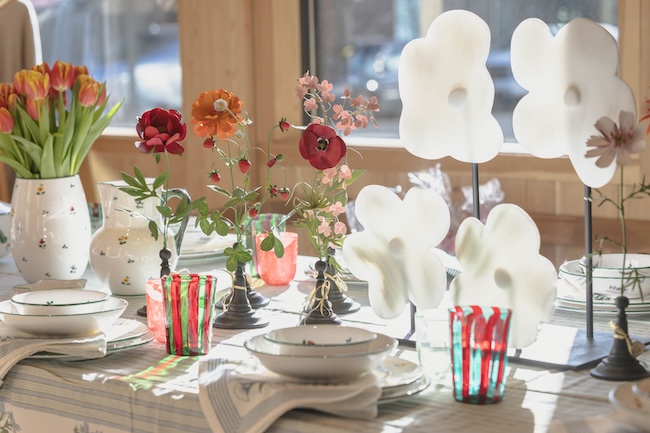
Katie von Strasser, founder of InspiratumColligere and its beautiful atelier in Jackson’s Arts District West, welcomes Scott and Elizabeth Christopher and their extraordinary artwork this summer. The boutique is filled with a unique and exclusive curation of merchandise from around the world.
Among the most compelling elements of the collection is the work of Scott and Elizabeth Hayes Christopher—art shaped by a moment as extraordinary as the pieces themselves.
On a clear August day—no storm, no warning—the earth erupted into a three-hundred-million-volt fireball, fracturing trees, launching stones, and leaving behind a moment that defied expectation.
What occurred was an extremely rare phenomenon known as “blue sky lightning,” a strike so unexpected it challenges the logic most of us associate with weather. Scott and Elizabeth, it was more than a near-death experience. It was a moment that fundamentally reshaped how they perceive the world—and the art they create within it.
“The lightning strike was mind-bending” Scott says. “Frightening, but also incredibly emotional—something that alters your perception in an instant.”
The two internationally recognized, multidisciplinary artists were standing outside their Santa Fe studio when the strike occurred. Between them was one of Elizabeth’s abstract figurative paintings, “Oneness and Interconnection.” In an instant, the current moved through Elizabeth, the canvas, and into Scott—an event as disorienting as it was transformative.
“It was a rebirth of sorts,” Elizabeth recalls.
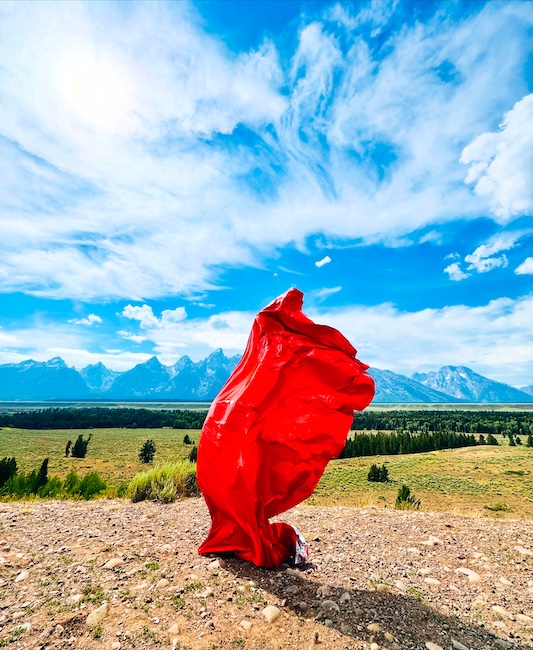
They survived, though not without injury; blue toes and eyes damaged, heart rates soaring. But what lingered most was not physical—it was perceptual. Colors sharpened. Energy felt more tangible. The natural world—already central to their work—took on a heightened immediacy. That shift manifested in their artistic practices, influencing both their individual work and their collaborative “Lightning Strike” performances and photographic art print series across the globe, from Greece to Venice to London, among other destinations.
For Elizabeth, the experience deepened a lifelong exploration of light, nature, and interconnectedness. Looking back, she sees echoes of it in earlier work—an intuitive pull toward energy and connection that had been actively evolving long before the strike. In the years since, that vision has expanded into a conceptual and visual language rooted in the idea that the experience planted something new within her. She explores this in her fascinating book of paintings and poetry, “Lightning Seeds.”
Those seeds have since grown into her current body of work: “Lightning Flowers.”
Rendered in a blend of botanical realism and dreamlike abstraction, Elizabeth’s paintings exist somewhere between the recognizable and the imagined. Her floral works are deeply informed by an education in horticulture and garden design. Petal-like forms bloom across paper and canvas, but they are not bound to any single species. Instead, they feel luminous, layered, and alive with motion. Colors shift and dissolve into one another—deep magentas, fiery oranges, and soft, atmospheric blues—creating compositions that feel both grounded in nature and lifted beyond it.
“They’re metaphorical doorways,” Elizabeth says. “Invitations for people to step into spaces of beauty, reflection, and possibility.”
Her process is as organic as the imagery itself. Working both in her studio and outdoors, she allows the environment to participate in the creation—rain marking the surface, wind shaping gesture, sunlight and time altering the final composition. Natural materials—flowers, grasses, seashells and found elements—become tools, leaving their imprint directly on the canvas. The result is work that feels less constructed than grown.
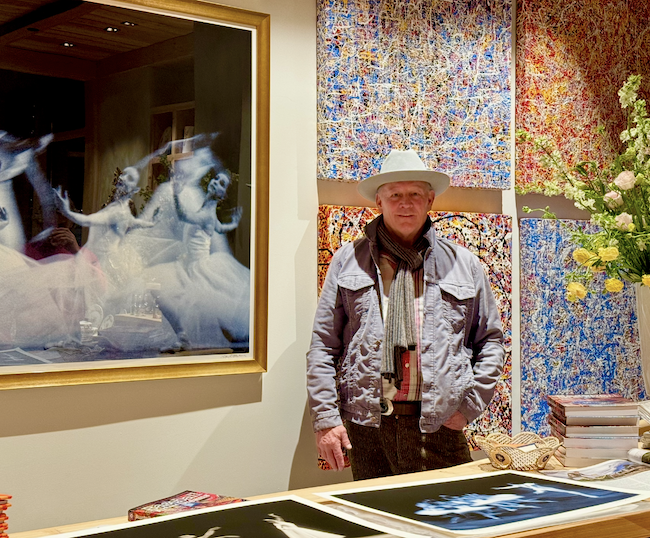
Scott’s work channels the experience in a different direction—toward scale, movement, and bold colors. His large-scale paintings—some reaching monumental proportions—are anchored in action painting, but expanded into something more immersive. Gesture drives the composition, with sweeping arcs and explosive marks capturing the kinetic force of the moment that inspired them. Scott’s process is physical and intuitive, shaped in part by his background as a professional baseball champion and record holder. He works primarily outdoors, where the open landscape becomes part of the creative process—often painting late into the evening under open skies.
His palette draws directly from the lightning event itself: “stark whites for innocence, deep blacks for the unknown, flashes of red for the explosion, golden tones for the branches shooting out from the fireball, and blue for the clarity of the sky.” The effect is immediate and visceral. These are not quiet works. They command space, inviting viewers to step into the energy rather than simply observe it.
Together, the artists’ practices diverge in form but align in intent—both seeking to translate an extraordinary moment into something tangible, shareable, and continually evolving.
A defining element of both artists’ work is their commitment to process—specifically, the integration of the natural world into creation itself. When working in their outdoor studio spaces, they actively collaborate with the elements. “Wind, snow, rain, unpredictable atmospheres, and the landscape are not obstacles, but contributors,” Elizabeth explains. Paintings are exposed to the environment over time, gathering subtle shifts and marks that cannot be replicated through controlled means. In Scott’s case, even the incorporation of materials like abandoned anthill particles becomes symbolic—an acknowledgment of collective energy and complex systems.
The result is art that feels dynamic and alive, shaped as much by environment as by intention.
That relationship between art and landscape resonates deeply in Jackson Hole, where the boundary between human experience and the natural world is constantly in motion. For Elizabeth, the connection is also personal. She first visited the area as a child—a formative experience that left a lasting impression. Returning years later to exhibit her work and create new pieces, the familiarity and joy was immediate.
“It felt like home,” she says.
That sense of return now finds a physical expression in “Lightning LOVE Ballet,” the Christophers’ exhibition at InspiratumColligere, where their work is on view.
In addition to their paintings, Scott’s historic photographs of the Bolshoi Ballet performing “Swan Lake” are on display.
Part gallery, part creative hub, InspiratumColligere has quickly established itself as a dynamic presence within Jackson’s evolving arts landscape. Founded by Katie von Strasser, the space brings together artists, designers, and innovators across disciplines—fostering not only exhibition, but exchange.
“InspiratumColligere is a curated global network and atelier… where visionaries in art, fashion, beauty, interiors, and technology gather to share ideas and find inspiration in one another’s work,” Katie explains of the innovative concept.
Within that context, the Christophers’ art feels particularly aligned. Their practice—grounded in exploration, collaboration, and the intersection of human experience with the natural world—reflects the broader ethos of the space itself.
For visitors, the exhibition offers more than a viewing experience. It invites a moment of pause—an opportunity to engage with work that is at once visually striking and conceptually expansive.
There is, undeniably, a remarkable element to Scott and Elizabeth’s story. But what ultimately resonates is something more tangible: a shared experience that challenged them, changed them, continuing to shape the way they create and offer their art to the world.
Their work does not ask viewers to fully understand the moment that sparked it. Instead, it offers something more accessible—an invitation to engage with the energy, beauty, and mystery that can emerge from even the most unexpected moments.
“Art is the universal language,” Scott summarizes. “It allows people to connect and relate beyond words.”
PARTNER CONTENT